The Capacity to Build
The opportunity opened by cheaper intelligence depends on systems that take years to develop. Science, infrastructure, skilled work, and competent institutions determine how much of the possible future becomes real.
Generation, storage, and transmission belong in the same conversation because the customer depends on the service they jointly provide.
Opening
Imagine a factory ready to open. The design is complete, the equipment has arrived, and customers are waiting. Its electricity connection is still unresolved. Every improvement made upstream now waits on a physical dependency that cannot be reasoned away.
That hypothetical scene captures a widening mismatch. Digital work can change in months. Grids, processing plants, laboratories, skilled workforces, and public institutions develop over years. A society can become exceptionally good at proposing its future while remaining unable to deliver the conditions that future requires.
My outlook is that accessible intelligence makes this productive capacity more consequential. More people equipped with AI, and more software acting on their behalf, can investigate problems, generate designs, and attempt research that previously lay beyond their reach. Selected ideas still have to earn funding, survive validation, and find a useful application. The ones that do create commitments for the systems that turn knowledge into dependable output.
Those systems begin with materials, energy, and intelligence, made useful by people capable of execution. Their strength determines whether a scientific result becomes a practical process, whether equipment becomes reliable service, and whether a country can respond when circumstances change. It also determines how much freedom a civilization has to pursue ambitious goals.
The urgency comes from the difference between these calendars. We should improve the slow parts while the range of possible work is expanding. Waiting for certainty about the ultimate reach of AI would leave the longest preparations until the moment they are most needed.
Give discovery somewhere to become knowledge
An immense opportunity exists in what humanity has already recorded. Papers, datasets, experimental results, technical manuals, and operating histories contain observations that are difficult to connect across disciplines. New intelligence can help search that inheritance, assemble evidence around an unanswered question, and identify a relationship worth testing.
There is room for a much larger scientific future. The “Stone Age” image captures a useful ambition: today's materials, energy systems, and biological understanding may look primitive from the perspective of what follows. We should leave room for discoveries that reorganize what is practical, including questions whose importance exceeds today's categories.
Computational research gives a sense of how far the starting point can move. The AlphaFold database makes more than 200 million protein-structure predictions openly available.1 The GNoME research reported 381,000 new crystal structures on an updated computational stability landscape.2 These are resources for investigation. A predicted structure is not comprehensive experimental knowledge; computational stability establishes neither a practical synthesis route nor a material that can be manufactured and sold.
As candidates multiply, experiments become more consequential. A useful test resolves an uncertainty that changes a decision. It asks whether a result survives the temperatures, impurities, loads, and failure conditions of its intended application. It produces measurements that another investigator can compare and reproduce.
Imagine a proposed material that appears promising in a model. The first question may be whether it can be made at all. The next may concern purity, durability, or how ordinary variation in feedstock changes its performance. A commercially useful process must eventually answer questions about yield, equipment, cost, and demand. The experiment should match the decision being made at each stage.
Laboratories, trained staff, instruments, reproducible procedures, and pilot equipment are therefore central infrastructure for an intelligence-rich economy. Automation can expand throughput, while domain expertise protects the meaning of the measurements. Provenance and records of failed experiments keep the next investigator from mistaking an untested possibility for an established result.
The opportunity compounds when the whole loop works: evidence improves models, models guide experiments, and experiments reveal useful materials and processes. Its speed depends on the quality and capacity of every stage. More predictions create value when good ideas can reach an informative test and the results can improve what comes next.
Deliver power to the work
The laboratory, computing facility, and manufacturing line each have a physical address. Energy becomes useful when it reaches that address at the required time, cost, and reliability. Generation, storage, and transmission belong in the same conversation because the customer depends on the service they jointly provide.
The IEA estimates that global data centres consumed 485 terawatt-hours of electricity in 2025. Its central projection reaches about 950 terawatt-hours in 2030, around 3% of global electricity demand. These figures cover all data centres, including the faster-growing AI-focused subset.3 They establish the scale of one infrastructure requirement; they do not measure the additional industrial activity that successful AI-enabled work may eventually create.
Annual totals conceal practical constraints. A region can generate abundant electricity over a year and still lack a usable connection for a new facility. Storage contributes particular services within a system. Transmission connects generation to demand. Switchgear, protection, cooling, maintenance, and operating practices determine whether the resulting supply is dependable.
Berkeley Lab's 2025 interconnection study shows the distance between proposed and operating capacity. At the end of 2024, U.S. transmission queues held requests for roughly 1,400 gigawatts of generation and 890 gigawatts of storage. Many requests ultimately withdraw. In regions with timing data, projects completed during 2018–2024 took a median of more than four years from request to operation.4 The factory in the opening example needs a connection it can use, not an impressive queue total.
Efficiency expands what existing infrastructure can accomplish. Better dispatch, lower losses, flexible loads, and higher equipment utilization can release useful capacity. New construction should follow credible needs, with explicit attention to uncertainty and the value of flexibility.
The larger demand thesis must remain equally disciplined. Cheaper intelligence can produce more engineering, prototypes, science, designs, schematics, simulations, and proposed experiments. Candidate generation uses compute and power; selected, funded tests add laboratories, materials, fabrication, and skilled attention; validated deployments add sustained physical commitments. Better tools can also eliminate prototypes, substitute inputs, and reduce resources per result. The aggregate outcome depends on useful applications, budgets, buyers, and the capacity to proceed. The IEA's analysis likewise treats efficiency, uptake, and new applications as interacting forces.3
Preparing for an expansion of useful work therefore requires judgment. We need to improve delivery and build adaptable capacity before all demand is certain, while allowing evidence to govern the size and timing of commitments. An expectation of abundant intelligence cannot justify indiscriminate construction.
Follow the design back to its materials
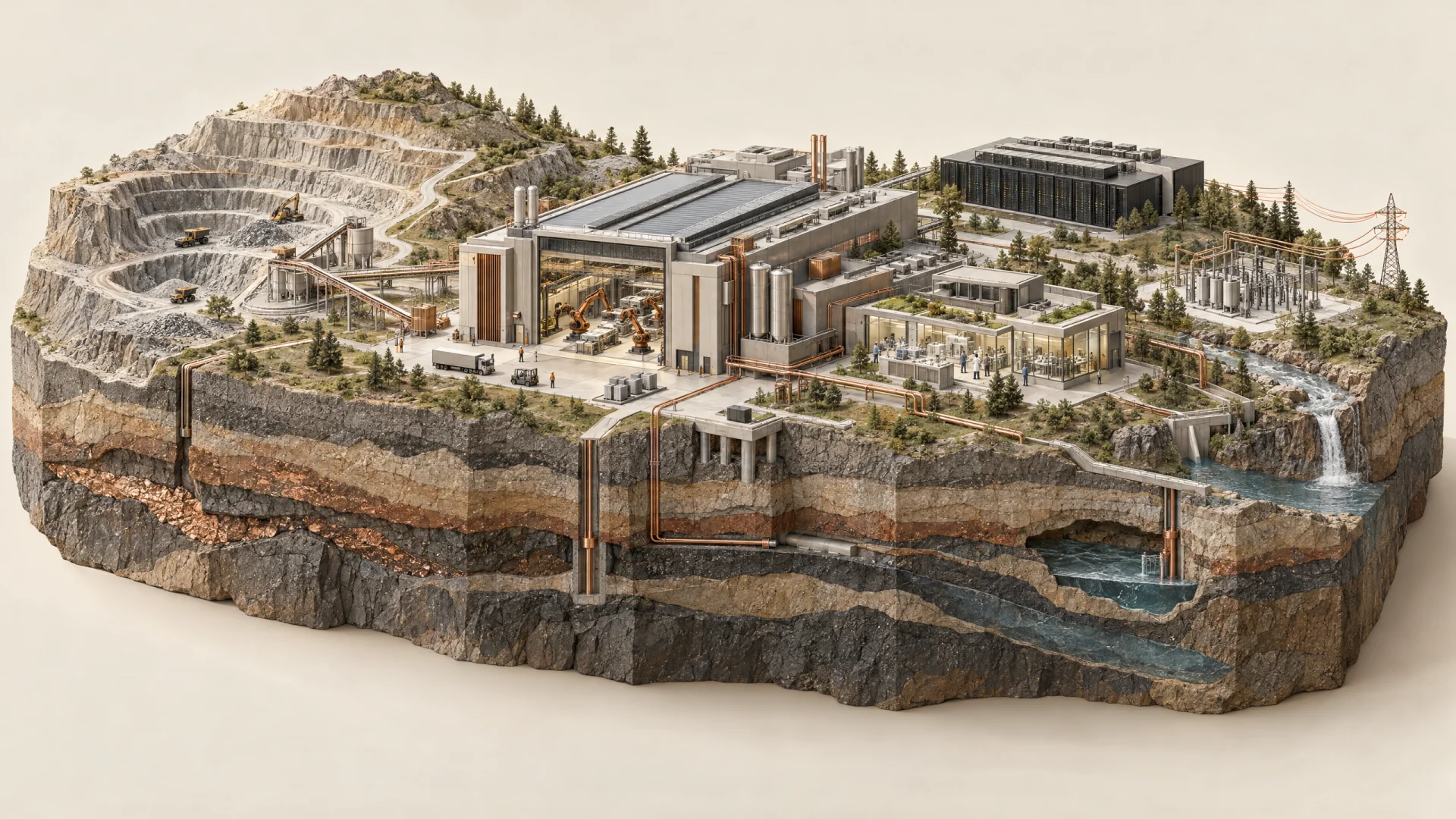
A design becomes physical through a bill of inputs: composition, purity, quantity, processing route, tolerances, and acceptable variation. Those requirements lead back to mines, refineries, chemical plants, recyclers, and transport networks. A material's availability in a usable form matters as much as its presence in the ground.
Price can obscure fragility. The IEA's 2025 minerals outlook found that the average share of the top three refining countries for key energy minerals rose from about 82% in 2020 to 86% in 2024, even as prices for several minerals declined.5 An affordable input may still be difficult to replace when processing capacity is concentrated.
The connection between discovery and production must therefore be considered early. A promising material can fail because its feedstock is inaccessible, purification is impractical, or the manufacturing process cannot tolerate ordinary variation. A useful improvement has to survive the route into a product that someone can depend on.
This opens a broad field for technical work: extraction, separation, recycling, substitution, process control, sensing, and designs that provide the same performance with less material. Better models can narrow promising process conditions. Better measurement can make variable feedstock manageable. Progress should appear in usable output, quality, cost, reduced waste, or lower dependency.
These relationships also prevent a simple story about rising commodity demand. More successful projects can increase demand for some inputs while better engineering reduces demand for others. A substitute can relieve one constraint and create another. The opportunity lies in understanding the system well enough to develop processing and manufacturing capacity that remains useful as designs change.
Materials, energy, and intelligence reinforce one another through this work. Intelligence can improve a process; power can make it operate; material quality can determine whether its output is useful. Execution is what connects the three.
Make competence worth acquiring
Robotics carries intelligence into physical action. Fabrication, handling, inspection, and maintenance expose a machine to tolerances, wear, awkward objects, interruptions, and faults that a clean demonstration may never encounter.
There is already a substantial industrial foundation. The International Federation of Robotics reported about 542,000 industrial-robot installations in 2024 and an operational stock of approximately 4.66 million.6 These figures describe industrial robots, rather than a deployed population of general-purpose autonomous workers.
Further gains depend on complete workflows. Perception, manipulation, inspection, fault recovery, and maintenance must work together. A robot that performs the nominal task quickly but frequently summons an operator can transfer the constraint into supervision. The economically meaningful standard is dependable performance over a full shift, including the events that interrupt it.
Skilled people remain central to that standard. The 2026 AGC/NCCER workforce survey reported continuing hiring constraints alongside uneven construction demand.7 BLS projects about 72,700 annual electrician openings over 2025–2035, including replacement and growth. Those openings are not a count of unfilled vacancies. Typical apprenticeships take four or five years.8 Documentation can become easier to search much faster than practical competence can be developed.
The response must address the actual constraint. Compensation, working conditions, retention, training, and better tools all shape available capacity. A hiring difficulty at a particular wage and location is not proof of a shortage of every kind of labor. A society that wants more physical work completed has to make competence worth acquiring and sustaining.
Assistance with diagnosis, preparation, inspection, and documentation can help experienced people perform and teach. It can preserve scarce attention for decisions that require it. Maintenance deserves the same respect as installation: a system's value depends on people long after its opening ceremony.
Someone must also own the complete result. The operator identifies dependencies, brings together the necessary skills, sets meaningful milestones, and remains responsible as plans change. Money can purchase equipment and support a team. It cannot itself supply that judgment. Substantial capital and powerful analytical tools can coexist with a shortage of people able to organize and finish the work.
Reindustrialization is the capacity to act
The same dependencies become matters of national consequence when a society must build, repair, replenish, or adapt at scale. Reindustrialization means developing the suppliers, skills, processes, energy systems, and institutions that make those responses possible. A new facility is an early milestone. Durable production and the ability to change course are the deeper achievement.
Federal government mobilization deserves attention in that light. Procurement, research support, infrastructure coordination, and sustained demand can help assemble capabilities that individual firms struggle to develop alone. The test is useful output and a stronger capacity to respond. Public ambition earns its value through what the resulting system can do.
Supply-chain security belongs within that effort. Critical dependencies must be understood, alternatives developed, repair capacity sustained, and relationships with reliable partners maintained. Industrial resilience includes the knowledge needed to change a process when a supplier or transport route becomes unavailable. A country needs more than inventories of finished products; it needs ways to keep producing and maintaining them.
Defense makes these questions concrete. The National Defense Industrial Strategy released in January 2024 emphasized resilient supply chains, workforce readiness, and flexible acquisition.9 These dated priorities express a lasting connection: technical capability depends on an industrial system able to produce, sustain, and replenish it. Readiness draws on capacity established before a crisis demands it.
The department CTO function belongs at this junction. The defense research-and-engineering office describes responsibilities spanning technology development and transition, prototyping, experimentation, and testing.10 I regard that connection between research leadership and usable capability as consequential. Its quality should be judged by how effectively promising work reaches the people who need it.
DARPA competitions offer a complementary mechanism: focus talent on a difficult problem with measurable conditions for success. In the 2025 AI Cyber Challenge final, competitors' systems found 54 unique synthetic vulnerabilities across 63 challenges and patched 43.11 That is a bounded result under defined conditions. Integrating the capability into the software and organizations that need protection is a further achievement.
The progression matters well beyond defense. Define a consequential problem. Give capable people and new suppliers a credible way to prove themselves. Evaluate the result, then carry successful work into sustained use. Federal mobilization becomes more productive when each of those transitions is designed to work.
Institutions are part of productive capacity
Every major physical project also passes through decisions. Someone must authorize construction, evaluate evidence, allocate capital, accept liability, and purchase the result. Faster technical work makes the quality of those decisions more consequential.
The concern that government has unfinished work from the web era is substantial. Aging systems, fragmented records, complex procurement, and obligations to maintain essential services accompany the arrival of AI. A faster interface can increase the volume of activity without increasing the institution's capacity to judge it.
GAO's July 2025 review identified eleven particularly critical federal legacy systems; modernization plans for eight did not fully include its key planning practices.12 An April 2026 review of selected federal AI acquisitions found difficulties obtaining technical expertise to evaluate proposals and understanding AI-related costs.13 These are specific federal findings. Local governments and other agencies need assessment on their own evidence.
The required functions are clear. A permitting authority needs to distinguish manageable risk from an unresolved problem. A procurement office needs to evaluate unfamiliar suppliers, learn from trials, and move successful work into use. Records need to make decisions explainable. People affected by an error need a way to challenge it. Liability and responsibility must remain identifiable when software participates.
Federal and local readiness should be assessed through these functions: sound decisions made promptly, usable evidence, continuity of essential services, contestable outcomes, and a capacity to learn. Some improvements require technology. Others require simpler procedures, better records, stronger technical expertise, and more authority for competent staff.
There is a development period here too. Hiring expertise, improving procurement, and earning public trust take sustained work. Waiting until automated activity overwhelms existing processes would leave society with more capacity to act than capacity to govern the consequences.
Competent institutions make more worthwhile work achievable and stop weak proposals before they consume years of effort. They are part of the productive system. They also help determine what its growing power will serve.

Give growing capability a constructive frontier
Space makes the whole argument tangible. A sustained presence beyond Earth requires dependable energy, materials processing, robotics, communications, manufacturing, and life support far from immediate help. It demands the complete passage from scientific understanding to equipment on which lives can depend.
NASA's December 2024 Moon to Mars architecture update illustrated this industrial substance. It selected fission power as the primary source for crewed operations on the Martian surface and added a lunar cargo lander and initial surface habitat to the architecture.14 These were planning decisions. Turning them into reliable capability is the frontier in practical terms.
Exploration can create demanding uses for resilient equipment, autonomous inspection, compact power, and efficient use of materials. These systems must earn their value in each application, including on Earth. Space supplies a further horizon against which to develop and test what humanity can accomplish.
The deeper question is where to direct growing power. More capable tools can intensify coercion and rivalry over what already exists. They can also enlarge knowledge, prosperity, and the range of futures available to human beings. A civilization should give its most capable people ambitions worthy of creation, discovery, and cooperation.
The stars cannot guarantee peace. The original Artemis Accords articulate principles of peaceful civil exploration, transparency, interoperability, and scientific-data release.15 Commitments require conduct behind them. Space can become another arena of destructive rivalry; its constructive potential depends on how exploration is governed and what societies choose to reward.
My conviction is that an expanding human future is worth deliberate effort. Better lives, stronger institutions, and greater resilience on Earth give that ambition substance. Exploration supplies a horizon large enough to challenge our capabilities and invite people into work that reaches beyond an immediate contest for advantage.
The factory imagined at the beginning can finally open when its connection delivers, its materials meet specification, its crew can run and repair the equipment, and the necessary public decisions have been made. Dependable output emerges from that coordinated competence. A frontier extends the ambition and raises the demands; it still begins with people making the complete system work.
That future begins in places whose calendars are already running: an apprenticeship, a transmission connection, a laboratory, a processing plant, a public office learning to make better decisions. Preparing them requires choices now about concrete needs, credible operators, processes worth rebuilding, evidence that earns trust, people and agents who will use the result, discoveries still hidden in existing knowledge, and purposes worth pursuing.
More accessible intelligence can widen the field of possible work. Productive capacity determines how much of it becomes available to others. Human judgment determines whether those achievements enlarge a future worth inhabiting.
The task is to build both the ability to act and the conviction to use it well.
Sources
Empirical references are carried forward from the source review dated 2 November 2026. They were not newly reverified for this edition. The factory and material-development examples are hypothetical; projections, dated plans, and experimental findings retain their stated scope.
- Google DeepMind and EMBL-EBI, About the AlphaFold Protein Structure Database, live documentation. More than 200 million computational protein-structure predictions. ↩
- Amil Merchant et al., Scaling Deep Learning for Materials Discovery, Nature, 29 November 2023; publisher DOI. The 381,000 figure concerns new entries on the updated computational stability landscape. ↩
- International Energy Agency, Key Questions on Energy and AI — Executive Summary, April 2026. Estimated 2025 consumption and conditional central projection for 2030 cover all data centres; efficiency, uptake, and changing applications affect AI electricity demand. ↩1 ↩2
- Lawrence Berkeley National Laboratory, Queued Up: 2025 Edition — Characteristics of Power Plants Seeking Transmission Interconnection as of the End of 2024, December 2025. Queue requests, attrition, and completion times in regions with available timing data. ↩
- International Energy Agency, Global Critical Minerals Outlook 2025 — Executive Summary, May 2025. Refining concentration across key energy minerals and lower prices alongside concentrated supply. ↩
- International Federation of Robotics, World Robotics 2025: Industrial Robots — Executive Summary, 2025. Industrial-robot installations and operational stock for 2024. ↩
- NCCER, AGC: Construction Workforce Shortages Remain Acute Despite Soft Market Conditions, 3 September 2026. Survey co-sponsor's account of the AGC/NCCER employer survey; hiring constraints and uneven construction demand. ↩
- U.S. Bureau of Labor Statistics, Electricians — Occupational Outlook Handbook, 2026 edition. Projected 2025–2035 openings include replacement and growth; typical apprenticeship duration is four or five years. ↩
- U.S. Department of Defense, DOD Releases First Defense Industrial Strategy, 12 January 2024; original strategy preserved by the Government Publishing Office. Dated industrial-resilience, workforce, and acquisition priorities. ↩
- DARPA, AI Cyber Challenge Marks Pivotal Inflection Point for Cyber Defense, 8 August 2025, updated results. Fifty-four unique synthetic vulnerabilities found and forty-three patched across the final competition's sixty-three challenges. ↩
- U.S. Government Accountability Office, Information Technology: Agencies Need to Plan for Modernizing Critical Decades-Old Legacy Systems, 17 July 2025. Selected critical federal systems and their modernization plans. ↩
- U.S. Government Accountability Office, Artificial Intelligence Acquisitions: Agencies Should Collect and Apply Lessons Learned to Improve Future Procurements, 13 April 2026. Thirteen acquisitions at four selected federal agencies; not an assessment of local-government readiness. ↩
- NASA, NASA Outlines Latest Moon to Mars Plans in 2024 Architecture Update, 13 December 2024. Architecture decisions on Mars surface power and lunar cargo and habitation elements; not deployed infrastructure. ↩
- NASA and original signatories, The Artemis Accords, 13 October 2020. Principles for peaceful civil exploration, transparency, interoperability, and scientific-data release. ↩